
Whether you’re a new graduate nurse or a seasoned RN, blood transfusion is one of those clinical procedures where confidence comes directly from knowledge. It’s not enough to know how to hang a bag — you need to understand what’s in it, why it was ordered, and what to watch for from the first drop to the last. This article breaks down the essential types of blood transfusions, when they’re used, and what every nurse needs to know to keep patients safe.

If you’re looking to earn contact hours in this area, Fast CE For Less offers a Blood Transfusion Types – 5 Contact Hour course as part of its unlimited CEU membership, with no test required and an instant certificate upon completion.
Why Component Therapy Changed Everything

For most of medical history, transfusion meant giving a patient whole blood. Today, that approach has largely been replaced by component therapy — transfusing only the specific fraction of blood a patient actually needs. A patient with anemia needs red cells, not clotting factors. A patient with a bleeding disorder may not need more volume. This precision approach reduces unnecessary risk, prevents fluid overload, and stretches the blood supply further. For nurses, it means getting familiar with several distinct products, each with its own purpose and considerations.
The Main Types of Blood Transfusions
Packed Red Blood Cells (PRBCs) are the most commonly ordered blood product. They are used when a patient’s ability to carry oxygen has been compromised — from acute blood loss during trauma or surgery, or from chronic anemia that has become symptomatic. Because plasma is removed during processing, PRBCs deliver red cells without placing unnecessary volume burden on the patient’s cardiovascular system.
Fresh Frozen Plasma (FFP) steps in when the clotting cascade is failing. Patients with severe liver disease, disseminated intravascular coagulation (DIC), or those who need emergency reversal of warfarin anticoagulation may require plasma to restore the clotting factors their body can no longer maintain on its own.
Platelets become necessary when counts drop dangerously low — a condition known as thrombocytopenia — leaving patients at risk of spontaneous bleeding. Platelet transfusions are common in oncology care, particularly for patients receiving chemotherapy or dealing with bone marrow failure. They provide temporary support while the underlying condition is being treated.
Cryoprecipitate is a concentrated product rich in fibrinogen and Factor VIII. It is used in massive transfusion situations, in patients with hemophilia A, or whenever fibrinogen levels have collapsed and standard measures aren’t enough to control bleeding.
Whole Blood, while rarely used in routine hospital care today, still has a place in trauma and military medicine where speed is critical and the patient needs simultaneous replacement of red cells, plasma, and platelets.
When Is a Transfusion Actually Warranted?
This is where clinical judgment matters as much as clinical knowledge. Not every patient with a low hemoglobin needs a transfusion. Current evidence supports a restrictive transfusion strategy — generally holding off until hemoglobin drops below 7 to 8 g/dL in stable patients, rather than acting on the number alone. A hemodynamically stable patient tolerates anemia very differently than one who is actively bleeding or in respiratory distress.
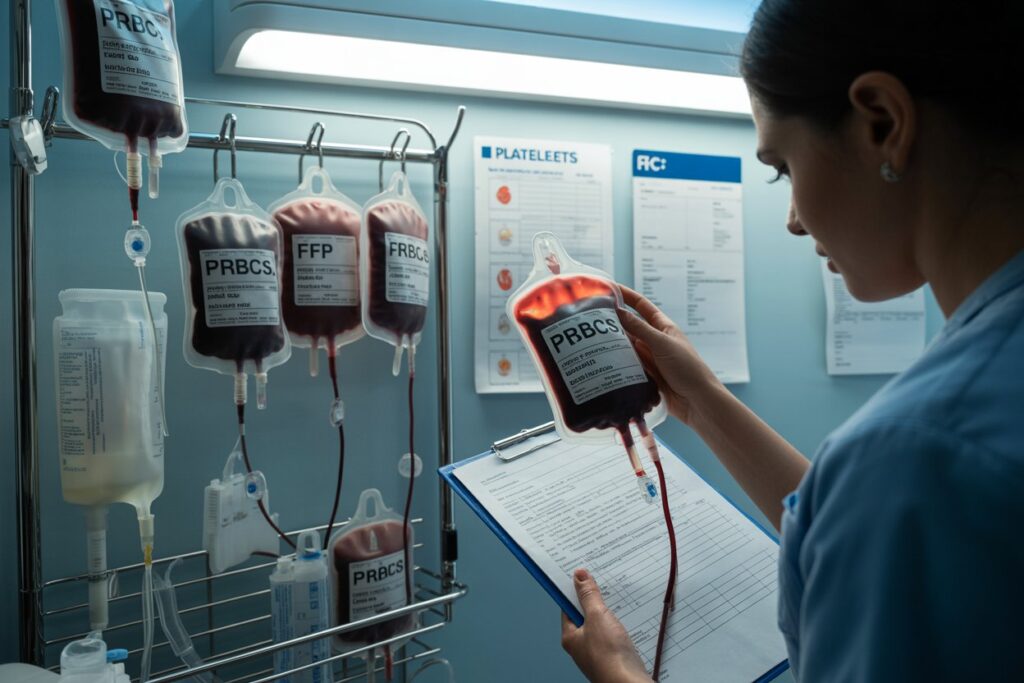
The decision to transfuse always involves weighing the expected benefit against the real risks of the procedure. That conversation belongs to the whole care team — and nurses are a meaningful part of it.
Walking Through the Transfusion Process
Blood administration follows a structured sequence because an error at any point can have life-threatening consequences. Here’s what that process looks like in practice:
The process starts with a verified physician order and a confirmed clinical reason for transfusion. The patient is identified using two identifiers, informed consent is obtained, and a blood sample goes to the lab for type and crossmatch — confirming ABO and Rh compatibility before the product ever leaves the blood bank.

At the bedside, two qualified staff members independently verify the unit label against the patient’s identity band and the physician’s order. This step prevents the most dangerous mistake in transfusion medicine: giving the wrong blood to the wrong patient. After verification, baseline vital signs are documented, the infusion begins slowly, and the nurse stays closely attentive for the first 15 minutes — when most acute reactions occur. Monitoring continues throughout and after completion, with thorough documentation at every stage.
Blood Compatibility: The Science Behind the Safety Check
ABO and Rh compatibility are non-negotiable. Transfusing incompatible blood triggers the immune system to attack the donated red cells, which can lead to kidney failure, shock, and death. Crossmatching adds an additional layer of protection by physically mixing donor and recipient blood in the laboratory to detect antibodies that standard typing might miss — including those developed through prior transfusions or pregnancy. A full serologic crossmatch is required anytime there’s uncertainty.
Recognizing Transfusion Reactions at the Bedside
Even when every protocol is followed precisely, adverse reactions can happen. Nurses who recognize them early change outcomes.
The reaction spectrum runs from mild to life-threatening. Febrile non-hemolytic reactions are the most common and, while uncomfortable, are generally not dangerous. Allergic reactions range from mild hives to anaphylaxis. Transfusion-associated circulatory overload (TACO) is increasingly recognized in older patients and those with cardiac or renal disease, presenting with signs of pulmonary edema. TRALI — transfusion-related acute lung injury — is less common but carries significant mortality risk.
At the most dangerous end sits the acute hemolytic reaction, almost always caused by an ABO incompatibility from a patient identification error. The immune system destroys the transfused red cells rapidly, releasing hemoglobin into the bloodstream and potentially causing organ failure and shock within hours.
Any fever, chills, rash, itching, back or chest pain, difficulty breathing, hypotension, or dark urine during a transfusion means one thing: stop the infusion. Maintain IV access with normal saline, notify the physician and blood bank, collect blood and urine samples, and monitor continuously until the patient is stable.
The Nurse’s Role Goes Beyond the IV Pole
Nursing responsibility in transfusion covers the full episode of care — education, verification, administration, monitoring, reaction management, and documentation. It also means keeping patients in the loop. When patients understand what symptoms to report and why the verification steps are so deliberate, they become genuine partners in their own safety.
Staying current in transfusion practice is part of professional accountability. Guidelines update, products evolve, and the consequences of errors are severe. Structured CE helps nurses maintain the competency this area demands — and Fast CE For Less makes that easy with affordable, on-demand courses you can complete at your own pace, with no test required and an instant certificate when you’re done.
FAQs
Can a patient legally refuse a blood transfusion?
Yes. Any competent adult has the right to refuse transfusion, even if doing so puts their life at risk. The nurse’s role is to confirm the refusal is truly informed, document it carefully, and ensure the care team has time to arrange bloodless alternatives such as iron therapy, cell salvage, or erythropoiesis-stimulating agents.
What is a massive transfusion protocol?
A massive transfusion protocol (MTP) is a pre-planned, rapid response to life-threatening hemorrhage. It delivers red cells, plasma, and platelets in a balanced ratio to prevent coagulopathy from compounding blood loss. MTPs are activated in trauma, surgical, and obstetric emergencies where standard ordering simply can’t keep pace.
What is autologous transfusion, and who is it right for?
Autologous transfusion uses a patient’s own blood — collected before a planned surgery or salvaged and reinfused during the procedure. Because the patient receives their own blood, compatibility issues and immune reactions are eliminated. It works best for elective surgeries with predictable blood loss and for patients with rare blood types.
Why do some patients need irradiated blood products?
Irradiation inactivates donor T-lymphocytes in the product, preventing them from attacking the recipient’s tissues — a rare but nearly always fatal complication called transfusion-associated graft-versus-host disease (TA-GvHD). Irradiated products are standard for immunocompromised patients, premature infants, stem cell transplant recipients, and anyone receiving blood from a biological relative.
How long do blood products stay usable?
Packed red blood cells last up to 42 days under refrigeration. Platelets expire within five to seven days and require room-temperature storage with constant agitation. Fresh frozen plasma keeps for up to a year when frozen but must be used within 24 hours of thawing. Always confirm expiration times before starting any infusion.
Can medications interfere with a blood transfusion?
Yes. Normal saline is the only IV fluid that should run alongside blood — dextrose causes hemolysis and lactated Ringer’s contains calcium that promotes clotting. No other medications should share the same line. Also note that antipyretics and antihistamines can mask early reaction symptoms, so vigilant monitoring remains essential even in premedicated patients.
What is hemovigilance, and why does nurse reporting matter?
Hemovigilance is the systematic national and international tracking of transfusion errors and adverse events. When nurses report reactions and near-misses accurately, that data directly shapes clinical policy and training. Underreporting is a persistent problem in transfusion medicine — every undocumented event is a missed opportunity to prevent the next one.
How is transfusing a child different from transfusing an adult?
Pediatric transfusion is weight-based — red cells are ordered in milliliters per kilogram rather than by unit — and volumes are precisely calculated to avoid overloading small cardiovascular systems. Premature infants and immunocompromised children often require CMV-negative and irradiated products. Hypothermia, electrolyte imbalances, and IV access challenges add layers of complexity that require extra vigilance throughout.