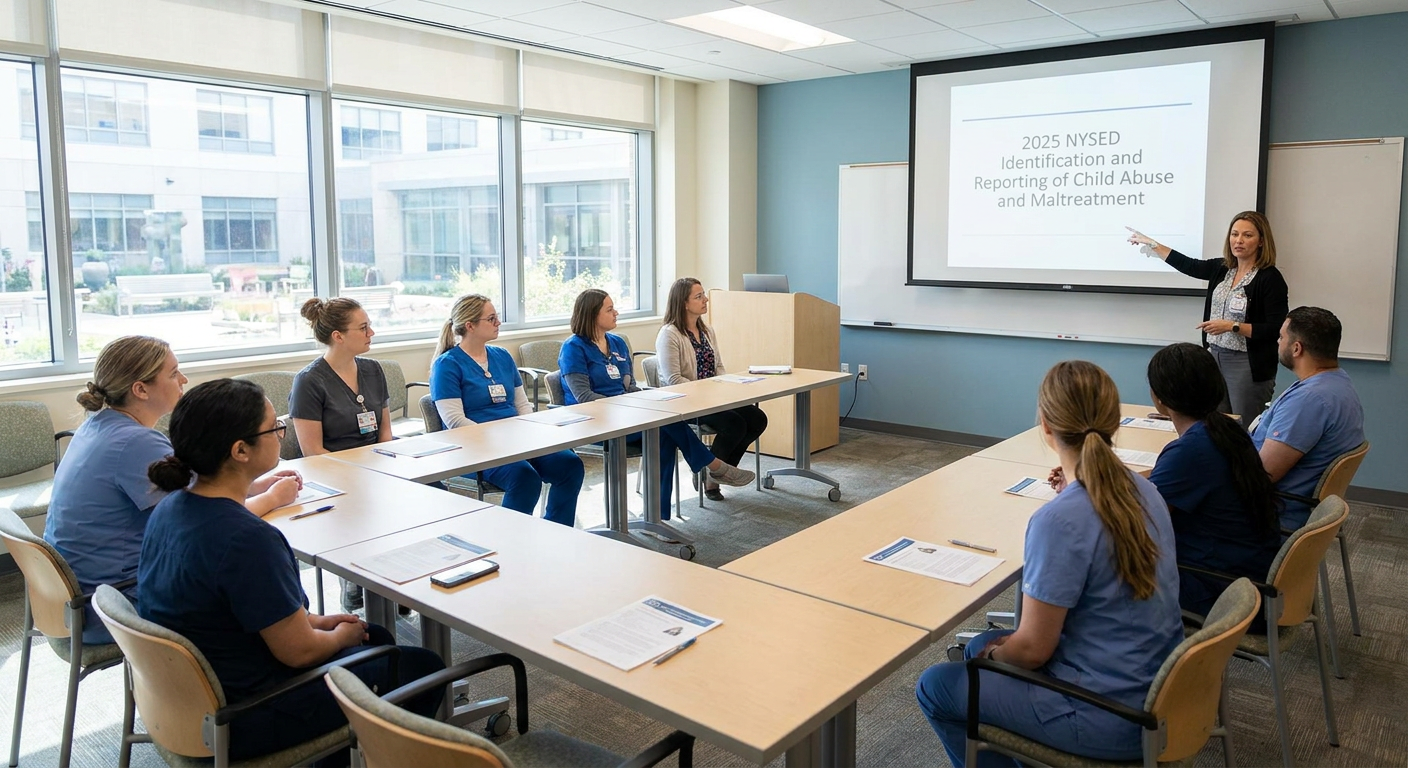
2025 NYSED Identification and Reporting of Child Abuse and Maltreatment
To provide mandated reporters of child abuse with an overview of the following: When legally required to call the SCR When children and families may be more appropriately assisted through community-based services or other supports Reduce bias in the decision-making process of whether a call must be made to the SCR The impact of trauma and Adverse Childhood Experiences (ACEs) on children and families Protective factors and the supports that can be referred to families to in lieu of making a report.
- Contact hours
- 2
- Format
- Self-paced, online
- Last reviewed
- —
$10.00or included with All-Access
$5 per contact hour · 2 contact hours
Secure checkout. Certificates issue instantly and stay in your vault even after a subscription ends.
- No post-test required · unlimited retakes · evaluation and attestation always required
Course Purpose
To provide mandated reporters of child abuse with an overview of the following: When legally required to call the SCR When children and families may be more appropriately assisted through community-based services or other supports Reduce bias in the decision-making process of whether a call must be made to the SCR The impact of trauma and Adverse Childhood Experiences (ACEs) on children and families Protective factors and the supports that can be referred to families to in lieu of making a report.
Continuing Education Credit Designation
This educational activity is credited for 2 contact hours at completion of the activity.
Overview
Child abuse and neglect are serious public health concerns. It involves the emotional, sexual, physical abuse, or neglect of a child under the age of 18 by a parent, custodian, or caregiver that results in potential harm, actual harm, or a threat of harm. This independent study provides an overview of child abuse, adverse childhood experiences, implicit bias, and the New York regulations for a mandated reporter to report child abuse and neglect.
Objectives
Upon completion of this independent study, the learner will be able to:
- Be able to determine if a child shows indicators of maltreatment or abuse, including in a virtual setting.
- Recognize the signs of intellectual and/or developmental disabilities in children and factors to consider when determining whether a child with intellectual and/or developmental disabilities shows indicators of maltreatment or abuse.
- Recognize the impact of trauma and ACEs on children, families, and the mandated reporter.
- Recognize the mitigating effects of the five protective factors on trauma.
- Recognize the impact of bias on decision-making.
- Understand when a mandated reporter has a legal obligation to call the SCR.
- Recognize how the mandated reporter may better connect individuals and families with services.
- Know how to prepare to make the call to the SCR.
- Know how to complete the LDSS 2221A form.
- Understand rights as a mandated reporter.
Policy Statement
This activity has been planned and implemented in accordance with the policies of FastCEForLess.com. This course should be used for informational purposes only and should not be used to diagnose, treat, prescribe, recommend, or initiate therapies or treatments in any setting. This course is copyrighted by Fast CE For Less, Inc. and may not be replicated, copied, or dispersed without written consent.
Disclosures
Fast CE For Less, Inc. and its authors have no disclosures. There is no commercial support.
Who this course is for:
Advanced Practice Registered Nurses, registered nurses, licensed practical or vocational nurses, and other healthcare providers in any setting who want continuing education on 2025 NYSED Identification and Reporting of Child Abuse and Maltreatment.
Course outline
38 sections · finish in any order across devices
- 1
Module 1: Introduction
- 2
Shared Mission
- 3
Trauma
- 4
Adverse Childhood Experiences (ACE)
- 5
Trauma-Informed Practice
- 6
Module 3: Understanding and Reducing Implicit and Explicit Bias
- 7
Causes of Child Abuse
- 8
Professional Role
- 9
Confidentiality
- 10
Immunity from Liability
- 11
Module 5: Defining Maltreatment and Abuse
- 12
Federal Child Abuse Prevention and Treatment Act (CAPTA)
- 13
Social Services Law and Article 10 of the Family Court Act
- 14
Penalties for Failure to Report
- 15
Abandoned Infant Protection Act
- 16
Module 6: Indicators of Child Maltreatment and Abuse
- 17
Abusive Head Trauma
- 18
Abdominal Trauma
- 19
Skeletal Trauma
- 20
Neglect
- 21
Physical Abuse
- 22
Sexual Abuse
- 23
Specific injuries and associated findings of child abuse include: 15
- 24
Fractures
- 25
Understanding Intellectual and Developmental Disabilities in Children
- 26
Communication Barriers
- 27
Concerning Behavioral Indicators of Caregivers to Children with IDD
- 28
The Virtual Environment
- 29
Educational Neglect
- 30
Exercise
- 31
Answer
- 32
Module 8: Making the Call to the SCR and What Happens Next
- 33
(LDSS 2221-A)
- 34
Special Considerations
- 35
Conclusion
- 36
Steps to Report Suspected Child Abuse
- 37
Child-Help USA
- 38
www.acf.dhhs.gov
References
The full reference list is included inside the course, after the Conclusion.
Purchase required to access Fast Facts, pretests, posttests, course evaluations and certificates. Our one free course is the only exception.
This Course Satisfies
Requirement summaries come from our state requirement records. All Users of Fast CE For Less’s website and content are responsible for knowing their state’s license and renewal requirements.
Update history
Take this course and the rest of the library
Unlimited annual access covers every course, every state you track, and your certificates forever.
ENROLLStill have a question?
Ask about requirements, a course, pricing or your license. Answers come from our own course list and state notes.
Answers come from Fast CE For Less's own course list and our notes on state requirements. Always check your board's own rules before you count hours.