
Asthma remains one of the most important chronic respiratory conditions encountered in clinical practice, making it a core topic in continuing education for nursing license renewal. For healthcare professionals completing nursing continuing education online, understanding current asthma treatment guidelines is essential for safe, evidence-based patient care.
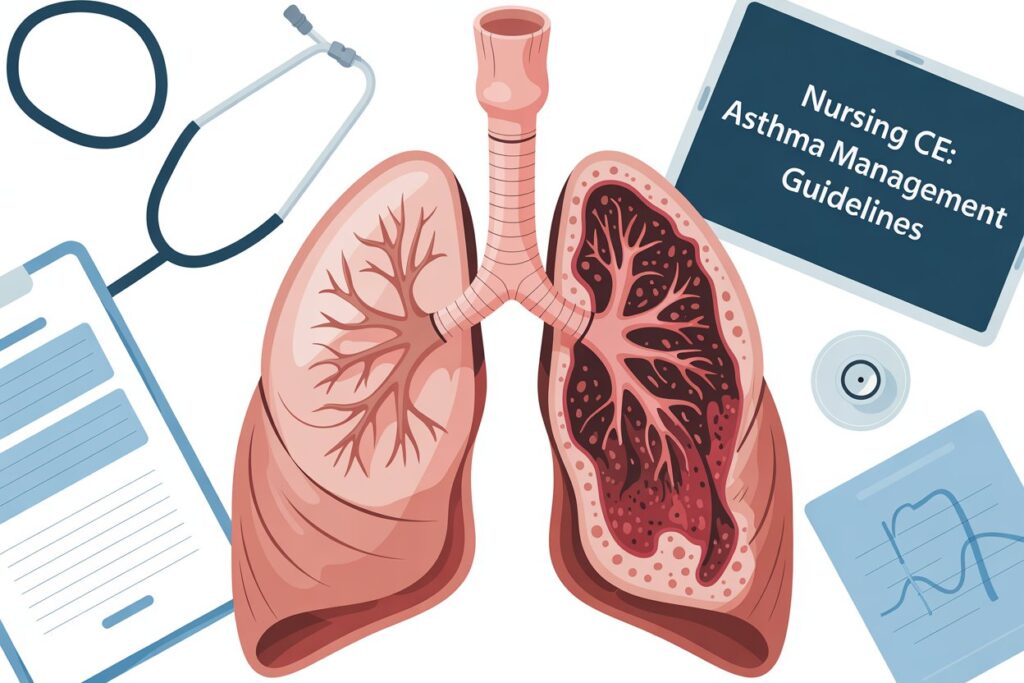
This article provides a structured, clinically relevant overview of asthma aligned with principles covered in online nursing ceu courses and flexible online ce programs. It is designed to support nurses seeking efficient learning formats such as fast ceus while maintaining clinical accuracy.
Overview of Asthma and Its Pathophysiology
Asthma is a chronic inflammatory airway disease characterized by reversible airflow obstruction and bronchial hyperresponsiveness. The condition involves narrowing of the airways due to inflammation, smooth muscle contraction, and mucus production.

Key pathological components include:
- Airway inflammation
- Bronchoconstriction
- Excess mucus secretion
- Increased airway sensitivity
These processes result in episodic respiratory symptoms that vary in intensity. Understanding these mechanisms is essential for nurses completing registered nurse ceu online modules focused on respiratory disorders and continuing education courses for nurses.
Immunologic Mechanism
Asthma often involves an IgE-mediated hypersensitivity response:
- Allergen exposure triggers immune activation
- Mast cells release histamine and inflammatory mediators
- Eosinophils contribute to ongoing airway inflammation
This immune cascade contributes to airway edema and hyperreactivity.
Common Triggers and Risk Factors
Asthma symptoms are frequently triggered by environmental and internal factors. Identifying these triggers is a key component of patient education and is commonly addressed in nursing ceus content.
Common triggers include:
- Dust mites, pollen, and mold
- Respiratory infections
- Cold air exposure
- Physical exertion
- Tobacco smoke and environmental pollution
- Emotional stress
- Gastroesophageal reflux disease (GERD)
Occupational exposure
Certain work environments may increase risk due to irritants:
- Chemical fumes
- Industrial dust
- Cleaning agents
Risk factors include:
- Family history of asthma or allergies
- Exposure to irritants or smoke
- Obesity
- History of atopic conditions
These topics are frequently included in nursing ceu online no test modules and free continuing education courses for nurses.
Clinical Presentation of Asthma
Asthma symptoms are episodic and can range from mild discomfort to severe respiratory distress.
Common symptoms:
- Wheezing (especially on expiration)
- Shortness of breath
- Chest tightness
- Persistent cough (often nocturnal)
- Reduced exercise tolerance
Severe manifestations:
- Difficulty speaking in full sentences
- Use of accessory muscles
- Cyanosis
- Diminished or absent breath sounds
- Increased heart rate and anxiety
Warning signs of deterioration:
- Declining peak flow readings
- Persistent hypoxia
- Altered mental status
Recognizing these findings is critical in clinical settings and is emphasized in nursing ceu online programs.
Diagnostic Approach to Asthma
Asthma diagnosis involves both clinical assessment and objective testing.

Key diagnostic tools:
- Spirometry (primary diagnostic test)
- Bronchodilator responsiveness testing
- Peak expiratory flow monitoring
- Methacholine challenge test (when diagnosis is uncertain)
Spirometry evaluates airflow limitation by measuring FEV1 and FVC, helping confirm reversible obstruction.
Additional evaluations:
- Allergy testing
- Chest imaging (to exclude other conditions)
- Fractional exhaled nitric oxide (FeNO) in select cases
These diagnostic principles are often covered in online nursing certificate programs.
Asthma Treatment Guidelines: Stepwise Approach
Current asthma treatment guidelines recommend a stepwise approach tailored to symptom severity and control.
Step 1: Intermittent symptoms
- As-needed low-dose inhaled corticosteroid (ICS) with a reliever inhaler
- Or combination inhaler used as needed
Step 2: Mild persistent symptoms
- Daily low-dose ICS
- Rescue inhaler as needed
Step 3: Moderate persistent symptoms
- ICS combined with a long-acting beta-agonist (LABA)
- Maintenance and reliever therapy (in some protocols)
Step 4: Severe persistent symptoms
- Medium to high-dose ICS + LABA
- Add-on therapies such as leukotriene modifiers
Step 5: Severe refractory asthma
- High-dose ICS + LABA
- Biologic therapies targeting specific inflammatory pathways
- Specialist referral
Understanding these steps is essential for nurses pursuing best online ceu for nurses, nursing ceus for less, and structured learning through online nursing ceu courses.
Pharmacologic Therapy Overview
Asthma medications are divided into relievers and controllers.
Reliever medications:
- Short-acting beta-agonists (SABA) such as albuterol
- Anticholinergics in acute care settings
Controller medications:
- Inhaled corticosteroids (reduce airway inflammation)
- Long-acting beta-agonists (used only in combination)
- Leukotriene receptor antagonists
- Biologic agents for severe cases
Nursing considerations:
- Monitor for oral candidiasis with inhaled steroids
- Reinforce mouth rinsing after inhaler use
- Assess adherence and technique regularly
These principles are commonly reinforced in free ceu courses.
Asthma Management Strategies
Effective management combines medication use with lifestyle and behavioral strategies.
Key strategies include:
- Avoiding known triggers
- Ensuring correct inhaler technique
- Adhering to prescribed therapy
- Monitoring symptoms using peak flow meters
- Developing a written asthma action plan
- Scheduling regular follow-up evaluations
Patient education is a major component of nursing continuing education online and supports improved outcomes in clinical practice.
Monitoring and Long-Term Control
Asthma control requires ongoing evaluation.
Monitoring methods:
- Symptom frequency tracking
- Peak expiratory flow measurements
- Spirometry at intervals
- Medication adherence review
Indicators of good control:
- Minimal daytime symptoms
- Rare nighttime awakenings
- Limited use of rescue inhalers
- Normal or near-normal lung function
If control is inadequate, treatment may need to be escalated according to guideline recommendations.
Management of Acute Asthma Exacerbations
Acute exacerbations require immediate intervention.
Initial management:
- Oxygen therapy to maintain adequate saturation
- Rapid-acting bronchodilators (SABA) via inhalation
- Systemic corticosteroids to reduce inflammation
- Frequent reassessment of respiratory status
Severe or refractory cases:
- Intravenous magnesium sulfate
- Epinephrine in life-threatening situations
- Mechanical ventilation if respiratory failure develops
- ICU-level care
These emergency principles are frequently included in no test ceu for nurses and free ceus for nurse practitioners focused on practical clinical readiness.
Complications of Poorly Controlled Asthma
Without proper management, asthma may lead to:
- Frequent emergency visits or hospitalizations
- Reduced quality of life
- Airway remodeling and irreversible changes
- Increased risk of respiratory failure
- Elevated morbidity in severe cases
Adherence to guideline-based care significantly reduces these risks.
Asthma in Special Populations
Asthma management may vary depending on patient characteristics.
Exercise-related symptoms:
Triggered by physical activity; often managed with pre-exercise medication.
Pregnancy:
Requires careful monitoring to maintain adequate oxygenation for both mother and fetus.
Pediatric patients:
May present with atypical symptoms such as recurrent coughing or feeding difficulties.
Older adults:
May have overlapping conditions that complicate diagnosis and treatment.
These variations are commonly addressed in online nursing ceu courses and advanced continuing education for nursing license renewal modules.
Role of Nurses in Asthma Care
Nurses are essential in both acute and chronic asthma management.
Key responsibilities:
- Patient education on medications and inhaler use
- Monitoring respiratory status
- Identifying early signs of deterioration
- Supporting adherence to treatment plans
- Coordinating care with healthcare teams
These responsibilities align with competencies reinforced through online nursing ceu courses, nursing ceu online, and structured professional development programs.
Importance of Continuing Education in Asthma Care
Staying current with asthma treatment guidelines is critical for safe clinical practice. Continuing education ensures nurses maintain competence in managing chronic respiratory conditions.
Flexible learning options such as free ceu courses support nurses in meeting licensing requirements while balancing busy schedules.
These platforms help professionals complete ceus for nursing license renewal, and access continuing education for nurses online in a convenient format.
Key Takeaways
- Asthma is a chronic inflammatory airway condition with reversible obstruction
- Symptoms are episodic and triggered by environmental and physiological factors
- Diagnosis is confirmed primarily through spirometry
- Asthma treatment guidelines follow a stepwise, individualized approach
- Nurses play a critical role in education, monitoring, and acute care
- Continuing education supports clinical competency and professional licensing requirements
- Proper management improves outcomes and reduces complications
Frequently Asked Questions (FAQs)
What are asthma treatment guidelines?
They are evidence-based clinical recommendations that guide diagnosis, classification, and stepwise management of asthma based on symptom severity and patient response.
What is the main goal of asthma treatment?
The primary goal is to control symptoms, prevent exacerbations, maintain normal lung function, and improve quality of life.
What medications are used for quick relief?
Short-acting beta-agonists (SABA) such as albuterol are commonly used for immediate symptom relief during asthma episodes.
What medications are used for long-term control?
Inhaled corticosteroids are the cornerstone of long-term therapy, often combined with long-acting beta-agonists in moderate to severe cases.
How do nurses contribute to asthma management?
Nurses educate patients, monitor respiratory status, assess inhaler technique, and support adherence to treatment plans.
What indicates poor asthma control?
Frequent symptoms, nighttime awakenings, increased use of rescue inhalers, and reduced lung function suggest poor control.
Can asthma symptoms be completely eliminated?
Asthma cannot be cured, but symptoms can be effectively controlled with proper treatment and avoidance of triggers.
Why is continuing education important for asthma care?
Continuing education helps nurses stay updated on asthma treatment guidelines, improve clinical decision-making, and fulfill requirements for professional license renewal.