
A patient’s potassium spikes to 6.8, and the monitor shows peaked T-waves. The kidneys that once filtered that potassium out have stopped working, and the nurse at the bedside has minutes to act, not hours.
Most continuing education content on end-stage renal disease (ESRD) repeats the same generic advice: eat less salt, watch your fluids, see a specialist. It skips the exact thresholds, lab values, and nursing actions that actually show up on the floor, on NCLEX-style questions, and on license renewal audits.
This guide covers ESRD causes, staging, symptoms, and treatment at a clinical level nurses can use immediately. It also shows you how to convert that knowledge into fast nursing CEUs that count toward your continuing education for nursing license renewal.
What End-Stage Renal Disease Actually Means
End-stage renal disease is stage 5 of chronic kidney disease (CKD). It occurs when the estimated glomerular filtration rate (eGFR) drops below 15 mL/min, confirmed on repeat testing.
At this point, the kidneys can no longer clear waste, balance electrolytes, or regulate fluid volume on their own. Patients need dialysis or a kidney transplant to survive. Without renal replacement therapy, toxins build up quickly and become fatal.
How Providers Diagnose ESRD
Diagnosis relies on two lab values tracked over time: eGFR and creatinine. A single low eGFR reading isn’t enough; providers confirm kidney failure with repeat testing over at least three months to rule out a temporary acute injury.
Urine tests check for protein and blood, which signal ongoing kidney damage even before eGFR drops. Imaging and, occasionally, a kidney biopsy help identify the underlying cause when the diagnosis isn’t clear from labs alone.
Who Develops ESRD: Causes and Risk Factors
Diabetes and hypertension together account for roughly 57% of all ESRD cases in the United States, according to USRDS data. Diabetic nephropathy damages the kidney’s filtering units over years of elevated blood sugar. Hypertension does the same by wearing down the small blood vessels inside the kidney.
Other leading causes include glomerulonephritis, polycystic kidney disease, lupus nephritis, and repeated urinary tract obstruction. According to the National Institute of Diabetes and Digestive and Kidney Diseases (NIDDK), citing the 2023 USRDS Annual Data Report, more than 808,000 people in the U.S. live with ESRD. About 68% receive dialysis, and 32% live with a transplant.
Risk is not distributed evenly. Men develop ESRD at 1.6 times the rate of women. Black Americans face more than four times the risk of White Americans, largely due to disparities in hypertension control and access to early CKD care.
Recognizing Symptoms Across Body Systems
ESRD symptoms rarely stay confined to the kidneys. Cardiovascular signs include hypertension, fluid overload, and heart failure from volume and electrolyte shifts. Cardiovascular disease remains the leading cause of death in ESRD patients, ahead of infection.
Hematologic and metabolic symptoms include anemia from reduced erythropoietin production, bone pain from mineral imbalances, and protein-energy malnutrition. Neurologic symptoms range from fatigue and impaired cognition to peripheral neuropathy and sleep disruption.
Integumentary and gastrointestinal signs round out the picture: dry, itchy skin, nail changes, nausea, vomiting, and loss of appetite. A patient rarely presents with just one of these. ESRD symptoms cluster and compound each other, which is why a systems-based assessment catches more than a symptom checklist does.
Hyperkalemia: The ESRD Emergency Nurses Can’t Miss
Hyperkalemia is one of the most dangerous, and most preventable, ESRD emergencies. Failing kidneys cannot excrete potassium, so levels climb quietly until they trigger a cardiac event.
Watch for peaked T-waves, widened QRS complexes, muscle weakness, and irregular heart rhythms. Confirm with a stat basic metabolic panel and repeat ECG if the value looks off.
Immediate management typically includes calcium gluconate to stabilize the cardiac membrane, insulin with dextrose to shift potassium intracellularly, and emergent dialysis for definitive removal. Know your facility’s hyperkalemia protocol before you need it, not while you’re reading orders under pressure.
Treatment Pathways: Dialysis, Transplant, and Medication
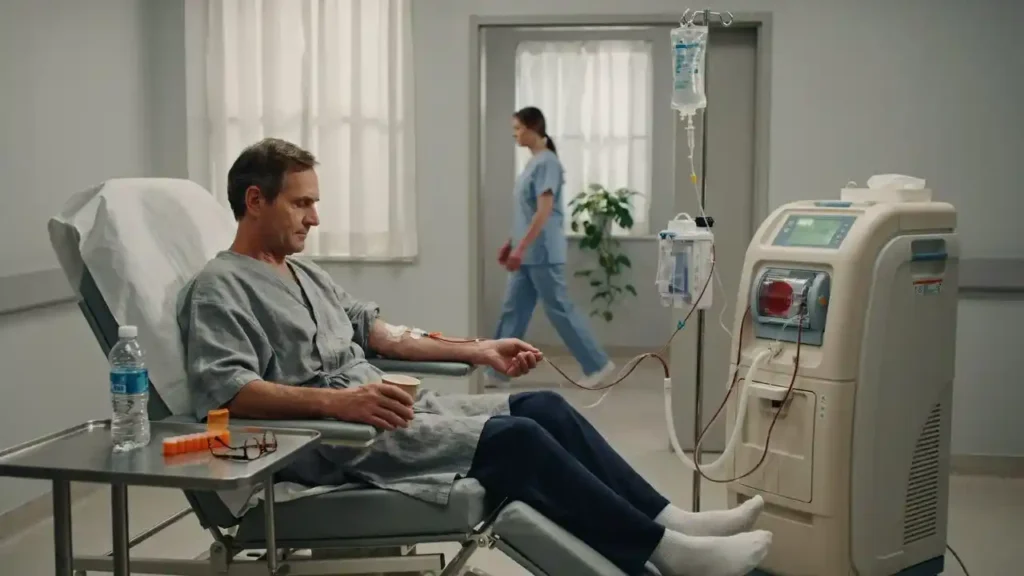
Hemodialysis filters blood through a machine, typically three times a week for three to four hours per session, using a fistula, graft, or catheter for access. Peritoneal dialysis uses the patient’s own peritoneal membrane, with fluid exchanges done daily, often at home.
Peritoneal dialysis gives patients more schedule flexibility and fewer dietary restrictions than in-center hemodialysis, which makes it a strong option for working patients. It does require the patient or a caregiver to manage exchanges consistently and correctly at home.
A kidney transplant offers the best long-term outcome for eligible patients, though it requires lifelong immunosuppression. Not every patient qualifies, and dialysis often bridges the wait for a donor organ. Early referral for transplant evaluation, ideally before a patient starts dialysis, improves the odds of a shorter wait.
Medication management supports both pathways. Phosphate binders, active vitamin D, and calcimimetics manage bone and mineral disorder. Erythropoietin-stimulating agents treat anemia, while ACE inhibitors or ARBs help control blood pressure and slow further kidney damage in patients not yet on dialysis.
The Nurse’s Role in Patient Education and Long-Term Care
Nurses drive the day-to-day success of ESRD management more than any other part of the care team. Dietary counseling on sodium, potassium, phosphorus, and fluid limits directly prevents emergency admissions. A renal dietitian sets the plan, but the nurse reinforces it at every visit.

Dialysis access care prevents infection and clotting, two of the most common reasons patients return to the hospital. Daily assessment of the fistula, graft, or catheter site catches problems before they become emergencies.
Emotional support matters just as much as clinical care. ESRD reshapes a patient’s entire schedule, diet, and identity, and many patients experience depression or caregiver burnout within their families. A nurse who addresses that reality, not just the labs, delivers better outcomes.
Turn This Knowledge Into Fast, Affordable Nursing CEUs
You don’t need to spend a weekend or a paycheck to meet your state’s requirements. Fast CE For Less built its ESRD course around exactly the content above: causes, testing, acute complications like hyperkalemia, and dialysis modalities, worth 3 contact hours toward continuing education courses for nurses.
There’s no timed test to pass. Complete the independent study, finish a short evaluation, and download your certificate the same day. That’s what “no test CEU for nurses” should actually mean: real clinical content, without the exam anxiety.
If you’re building out your renewal hours, start with 100% free nursing CEU courses on topics beyond ESRD, then add this course and any others you need from the full nursing CE course catalog through one affordable all-access pass. It’s continuing education for nursing license renewal that respects both your time and your budget, whether you’re an RN, LPN, or nurse practitioner searching for free CEUs for nurse practitioners.
Your Next Step
Know the eGFR threshold, the hyperkalemia protocol, and the dialysis options cold. Then get credit for knowing them.
Enroll in the End-Stage Renal Disease CEU course and finish your contact hours today.
How many contact hours does the ESRD course provide?
Fast CE For Less credits this course for 3 contact hours, which count toward most state continuing education courses for nurses requirements.
Do I have to take a timed test to pass?
No. Complete the independent study material and a short evaluation, then download your certificate. There’s no timed, scored exam to fail.
Is this course accepted for RN license renewal in my state?
Course accreditation varies by state board. Check your specific state’s continuing education for nursing license renewal requirements before your renewal deadline, since accepted hour types and topics differ.
What’s the difference between chronic kidney disease and end-stage renal disease?
CKD refers to any stage of declining kidney function, measured in five stages by eGFR. ESRD is stage 5 specifically, where eGFR falls below 15 mL/min and the kidneys can no longer sustain the body without dialysis or transplant.
Can nurse practitioners use this course toward their renewal hours?
Yes. Nurse practitioners can apply the contact hours from this course toward continuing education requirements, and Fast CE For Less also offers free CEUs for nurse practitioners on separate topics to help round out a renewal cycle.