Domestic violence affects an estimated 10 million people in the United States every year, with roughly 25% of women and 11% of men experiencing family or domestic violence at some point. Statistically, this means nearly every nurse, in nearly every setting, will encounter a victim of domestic violence — often without realizing it. The uncomfortable truth is that healthcare providers routinely miss these signs of domestic violence, not because they don’t care, but because most were never trained to recognize the subtle, non-obvious indicators that don’t look like the injuries seen in textbooks.
Why the Signs of Domestic Violence Get Missed
Domestic violence rarely announces itself with an obvious bruise pattern. Victims often present with vague complaints — chronic headaches, unexplained anxiety, gastrointestinal symptoms, or injuries explained away with an inconsistent story. Add time pressure, a partner present in the exam room, and a lack of standardized screening protocol, and it becomes easy to understand why so many cases go unidentified. Nurses are frequently the first, and sometimes only, healthcare professional a victim interacts with before returning home to an unsafe situation.
The Layers Nurses Need to Understand About Domestic Violence
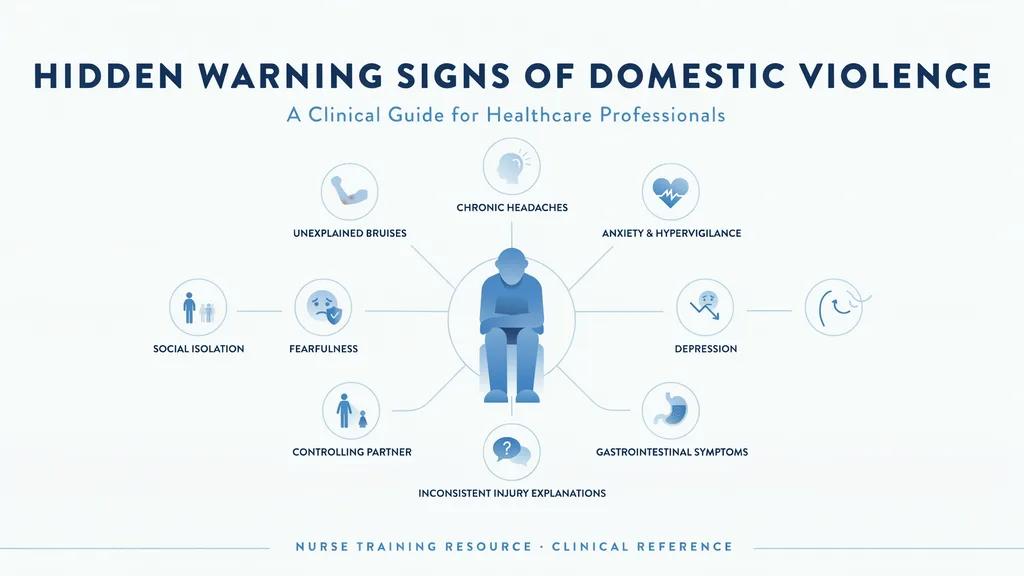
Effective domestic violence training doesn’t stop at “look for bruises.” It needs to cover:
- Risk factors and behavioral red flags across intimate partner violence, child abuse, and elder abuse
- How power and control dynamics develop between a caregiver, parent, or partner and a victim
- Legal frameworks like the Violence Against Women Act and the Elder Justice Act
- How abuse presents differently within the LGBTQ community
- Documentation standards and mandatory reporting responsibilities
- Available victim resources and how to connect patients to them safely
This is precisely the structure behind the Domestic Violence course offered through Fast CE For Less — a 3-contact-hour, independent-study program designed to walk healthcare providers through identification strategies, legal context, and resource navigation in a format that’s genuinely usable on a busy floor, not just theoretical.
A Compliance Requirement With Real Consequences
For most nurses, domestic violence training isn’t optional reading — it’s a required component of continuing education courses for nurses in many states. But treating it purely as a box-checking exercise misses the point. Every hour spent understanding risk factors and reporting protocols is an hour that could directly change the outcome for a patient sitting in front of you. That’s a rare case where the state’s licensure requirement and genuine clinical value point in exactly the same direction.
Finding a Domestic Violence CEU That Respects Your Time
Nurses searching for domestic violence CEUs are often doing so under real time pressure — a license renewal deadline, a new job requirement, or a state mandate they just discovered. This is where the appeal of fast ceus and no-test CEU for nurses options becomes obvious: a well-designed independent study course lets you read focused material, complete a short evaluation, and receive an instant certificate, rather than scheduling a live seminar or sitting through hours of video lecture. For nurses comparing cheap nursing CEU options, it’s worth remembering that the lowest price only matters if the course is actually accepted by your state board and reports correctly to CE Broker where required.
Checking Whether a Provider Delivers on Its Promises

Because continuing education is tied to both professional competence and licensing compliance, it’s important to evaluate a provider before enrolling. Look for clear information about course accreditation, state acceptance, certificate availability, pricing, and the overall learning format. A trustworthy provider should be transparent about its approval status, offer straightforward course access, and make it easy for healthcare professionals to complete their continuing education requirements efficiently.
Turning Awareness of Domestic Violence Into Action
The gap between knowing domestic violence is common and knowing how to act on suspicion is where most missed cases live. Structured continuing education closes that gap by giving nurses a repeatable framework: recognize the risk factors, document objectively, understand the legal reporting requirements in their state, and know exactly which resources to hand a patient before they leave the room. That framework doesn’t just satisfy nursing ceus for less — it equips nurses to be the person who actually notices what everyone else missed.
Frequently Asked Questions
Is domestic violence training required for every nurse, or only certain specialties?
Requirements vary by state and, in some cases, by licensure renewal cycle rather than specialty. Emergency, OB, and primary care nurses are especially likely to encounter victims, but the training itself is generally open to — and often required of — nurses across all practice settings, not just those areas.
What’s the difference between “domestic violence” and “intimate partner violence” in clinical terminology?
Domestic violence is the broader term, encompassing abuse between family members, caregivers, and partners, including child and elder abuse. Intimate partner violence refers specifically to abuse occurring between current or former romantic partners. Clinical documentation should use the term that most precisely matches the relationship involved.
Are nurses legally protected when they report suspected domestic violence in good faith?
Most states provide some form of legal immunity for mandatory reporters who report suspected abuse in good faith, even if the suspicion later proves unfounded. Protections vary by state and by the type of abuse reported, so nurses should understand their specific state’s immunity statute rather than assume blanket protection.
How does domestic violence training differ from human trafficking recognition training?
While there’s overlap in risk-factor identification, human trafficking training focuses specifically on coercion, control by a third party for exploitation, and indicators like inconsistent personal documentation or a companion who won’t leave the room. Domestic violence training centers more broadly on power-and-control dynamics within family and intimate relationships.
Can domestic violence CEU hours count toward general elective requirements if my state doesn’t mandate the topic?
In most states, yes — domestic violence coursework typically qualifies as a general or elective contact hour even where it isn’t specifically mandated, since it falls under recognized categories like patient safety or vulnerable population care. Confirm the course’s accreditation details against your board’s elective category definitions.